FluxCrane is an advanced, fully automated gantry crane system designed for high-resolution monitoring of greenhouse gas (GHG) and evapotranspiration (ET) fluxes. It integrates closed canopy chambers with proximal sensors to track crop development, canopy temperature, and vegetation indices (e.g., NDVI, RVI). By combining high-frequency flux data with detailed phenological observations, FluxCrane enables precise, process-level insights into carbon, nitrogen, and water dynamics in agroecosystems.
For a more detailed view, please click on the image.
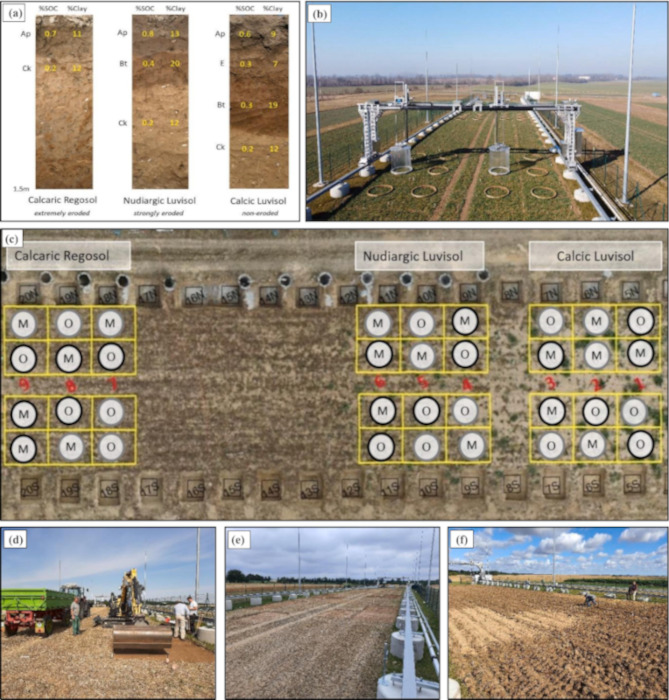
(a) Three distinct soil types (Calcaric Regosol, RG-ca: extremely eroded; Nudiargic Luvisol, LV-ng: strongly eroded; and Calcic Luvisol, LV-cc: non-eroded) present in the study area representing three soil erosion states, (b) FluxCrane at an area of 110 m × 16 m instrumented at “AgroFlux” platform, (c) the spatial arrangement design of 36 plots ((n = three per factor combination) with non-diluted topsoil represented by a black outlined circle, diluted topsoil by a grey-outlined circle, and mineral and organic fertilized plots denoted by letter “M” and “O” inside the circle (d) Implementation of topsoil dilution (e & f) by removing the upper 6 cm of topsoil and adding/mixing equivalent weight of subsoil into it. © Shrijana Vaidya (Figure taken from Vaidya et al., 2024)
|